
By Tilly Baden, Assistant Team Manager, Mental Capacity Act Team, Dorset Council.
“As the [Mental Capacity] Act and the European Convention [of Human Rights] make clear, a conclusion that a person lacks decision-making capacity is not an “off-switch” for his rights and freedoms. To state the obvious, the wishes and feelings, beliefs and values of people with a mental disability are as important to them as they are to anyone else.”
- Peter Jackson J (as he then was) in Wye Valley NHS Trust v Mr B [2015] EWCOP 60
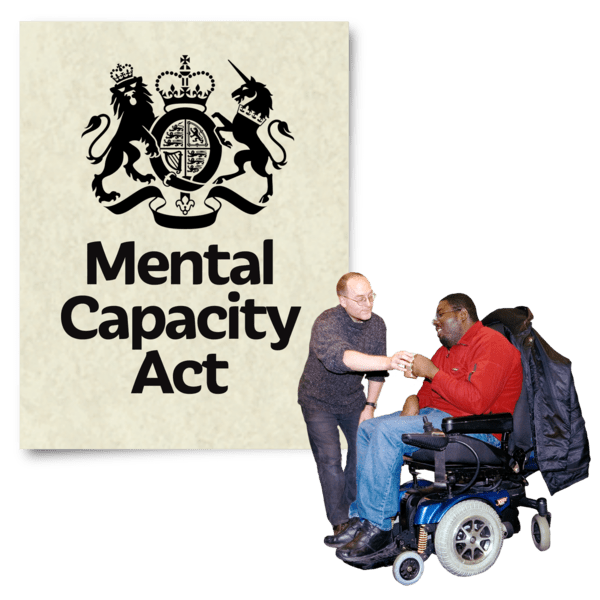
The Mental Capacity Act (MCA), alongside the Human Rights Act (HRA), are two amazing pieces of legislation. Whilst they may have some faults, their ethos underpins all our work.
The MCA ensures that the fundamental rights of everyone are respected, and that people are empowered to make their own decisions wherever possible. They ensure that safeguards are followed if restrictions on liberty are required for people with a mental disorder. The MCA enables people to plan for their future for a time when they cannot make decisions for themselves, and also ensures that when decisions are made on a person’s behalf, that person is still involved, and their wishes and beliefs are promoted. Everyone working with (or caring for) any person from the age of 16 must comply with the MCA.
What we do.
Here at Dorset Council’s Mental Capacity Act (MCA) Team, maximising a person’s human rights and autonomy is at the heart of everything we do. Our task is to ensure that every citizen of Dorset who receives care, gets this support in accordance with the principles of the Mental Capacity Act (2005).
To achieve our task, Dorset Council’s MCA team has three functions:
1. To provide expert advice and guidance to professionals and care staff working in Dorset on MCA issues.
2. To provide bespoke training to Dorset Council staff, and staff within partner organisations including the independent and voluntary sector, on MCA best practice.
3. To coordinate and oversee the provision of Deprivation of Liberty Safeguards (DoLS) authorisations for Dorset citizens.
What are the principles of the MCA?
The five principles are defined in part 1 of the MCA, and are set out in the following table:
Principle In Practice:
| Principle | In Practice | |
| 1 | A person must be assumed to have capacity unless it is established that they lack capacity. | Every person from the age of 16 has a right to make their own decisions if they have the capacity to do so. Practitioners and carers must assume that a person has capacity to make a particular decision at a point in time unless it can be established that they do not. |
| 2 | A person is not to be treated as unable to make a decision unless all practicable steps to help him to do so have been taken without success. | People should be supported to help them make their own decisions. No conclusion should be made that a person lacks capacity to make a decision unless all practicable steps have been taken to try and help them make a decision for themselves. |
| 3 | A person is not to be treated as unable to make a decision merely because he makes an unwise decision. | A person who makes a decision that others think is unwise should not automatically be labelled as lacking the capacity to make a decision. |
| 4 | An act done or decision made, under this Act for or on behalf of a person who lacks capacity must be done, or made, in his best interests. | If the person lacks capacity any decision that is made on their behalf, or subsequent action taken must be done using Best Interests, as set out in the Act. |
| 5 | Before the act is done, or the decision is made, regard must be had to whether the purpose for which it is needed can be as effectively achieved in a way that is less restrictive of the person’s rights and freedom of action. | As long as the decision or action remains in the person’s Best Interests it should be the decision or action that places the least restriction on their basic rights and freedoms. |
Our work with advocacy services.
We work very closely with advocacy services to ensure that the voices of those who have been assessed to lack capacity to make a specific decision are heard and respected.
For many people, they have family members and friends who can advocate on their behalf when big decisions need to be made, such as moving to a new home or having an operation in hospital. They will ensure that the decision-maker has all the relevant information about the person’s past and present wishes and will ensure that their views are represented fairly.
However, for some people, they won’t have anyone who can advocate on their behalf. They may not be in contact with any relatives or friends, and they may only have paid care staff to support them. In these circumstances, they will need an Independent Mental Capacity Advocate (also known as an IMCA) when a big decision needs to be made and the person has been assessed as lacking capacity to make this decision themselves.
An IMCA will meet with the person and get to know their views, preferences and wishes. They will talk to people around them to build up a picture about that person’s life. The IMCA will ensure that the person’s voice is heard and will check that professionals are adhering to the law.
When a person is deprived of their liberty in a care home or hospital, they will need someone to act on their behalf and support them to raise an application to the Court of Protection if they do not agree with their care and treatment. This is known as the Relevant Person’s Representative (RPR).
Sometimes, a specialist advocate will act in this role if there is no one suitable to support the person. This is known as a Paid Representative. The Paid Representative provides vital checks and balances to ensure that the hospital or care home complies with any conditions attached to the DoLS authorisation and ensure that the person has an absolute right of appeal to the DoLS within Court.
Case study.
Joan* is 92 years old and has been admitted to hospital with a broken ankle following a fall. Joan has Alzheimer’s Disease and finds it difficult to remember certain things. Joan can become confused and forget where she is and why she is there.
Whilst in hospital, the doctor assesses her to lack capacity to consent to her care and treatment. The doctor believes it to be in Joan’s best interests to remain in hospital whilst she can recover from her broken ankle and receive necessary rehabilitation whilst she heals.
Joan has a sister who lives in Canada, but she hasn’t seen her in several years. Joan’s husband died a few years ago. Joan has no other family members or friends who can support her.
Joan is unsettled on the hospital ward and keeps saying that she wants to go home.
A DoLS authorisation is needed as Joan is being deprived of her liberty in the hospital and cannot consent to this. Joan is referred for an IMCA.
Simon*, an IMCA, meets with Joan and gets to know more about her. Simon supports Joan during the DoLS assessment and ensures that her wishes are represented. The DoLS authorisation is granted as it is in Joan’s best interests to receive the treatment in hospital, but her objections are noted. Simon is appointed as Joan’s Paid Representative.
Joan’s social worker, Tina*, and Joan’s doctor, Dr Smith*, believe that Joan needs to finish her rehabilitation in hospital and then be discharged to an interim care home to help her regain her strength and ensure that she receives around-the-clock care. Joan continues to say she wants to go home, so her case will be heard by a Judge.
Following discussions with Joan, Simon instructs a solicitor to act on Joan’s behalf. The solicitor lodges an application with the Court of Protection to challenge the DoLS authorisation.
Everyone recognises that there are significant risks if Joan were to be discharged to her own home, but Simon ensures that Joan’s voice is heard clearly throughout. Simon shares that Joan has always been an independent woman and she has lived in her own home for more than 40 years. The Judge assesses all the evidence and listens carefully to what everyone has to say.
The Judge orders that Joan should be supported to return home as per her wishes. Tina is tasked with organising a package of care to support Joan in her own home. Whilst the plan is not without risk, and it is possible that Joan may have another fall or accidentally harm herself in some way
whilst at home, the Judge said that Joan’s strong wishes to return home need to be respected. Joan is discharged from hospital with a package of care in place.
Simon has ensured that Joan had her absolute right to appeal her DoLS authorisation and her case was heard by the Judge; thus, protecting her fundamental human rights.
*Names and details have been altered to protect anonymity.
“The fact is that all life involves risk, and the young, the elderly and the vulnerable, are exposed to additional risks and to risks they are less well equipped than others to cope with. But just as wise parents resist the temptation to keep their children metaphorically wrapped up in cotton wool, so too we must avoid the temptation always to put the physical health and safety of the elderly and the vulnerable before everything else. Often it will be appropriate to do so, but not always. Physical health and safety can sometimes be bought at too high a price in happiness and emotional welfare. The emphasis must be on sensible risk appraisal, not striving to avoid all risk, whatever the price, but instead seeking a proper balance and being willing to tolerate manageable or acceptable risks as the price appropriately to be paid in order to achieve some other good – in particular to achieve the vital good of the elderly or vulnerable person’s happiness. What good is it making someone safer if it merely makes them miserable?”
- Munby J (as he then was) in Local Authority X v MM and KM [2007] EWHC 2003 (Fam).
Final comment.
Good quality advocacy services are vital to ensuring that fundamental human rights are protected. Dorset Council are proud to work alongside partner advocacy services to ensure that the individual is kept at the centre of all decision-making. After all, we share the common goal in all wanting what is best for each person. No decision should ever be made about the person, without the person.
Contact details and useful information.
Dorset Council MCA Team:
- Sue Farmer – Specialist Manager
- Tilly Baden – Assistant Team Manager
Tel: 01305 225650 (Mon – Thurs 9am – 5pm; Fri 9am – 4pm) Email: [email protected]
Follow us on Twitter: @MCADorset
To find out more about the work we do, visit our website
MCA and Best Interests – Introduction to MCA leaflet
DOLS – Deprivation of Liberty Safeguards leaflet - for individuals and families